Everything affects everything
Thirteen Reasons Why“Everything affects everything” is Hannah Baker’s central expression of how harm spreads beyond the incident that first appears to contain it. What happens in one part of a person’s life reaches the whole: private distress, school life, relationships, and the possibility of asking for help cannot be neatly separated. The phrase gives the novel’s chain of choices and missed signals a governing logic, while warning against treating any one act as the sole cause of Hannah’s death.
The Principle of Interconnection
Hannah argues that no one can know all that happens in another person’s life, at home or at school. A person who interferes with one part of someone else’s life cannot control the extent of the damage; the effect is not precise or selective. Her compressed formulation, “Everything…affects everything,” makes that claim both an explanation of accumulated harm and a challenge to the assumption that an action can be judged in isolation.
The expression also shifts the scale of attention. A rumor, an intrusion, a failure to intervene, or a distress signal may appear to concern only one encounter. Hannah’s reasoning insists that each enters a life already shaped by other circumstances. The phrase therefore describes a network of consequences, not a simple chain in which one action alone explains what follows.
A Classroom Attempt to Be Heard
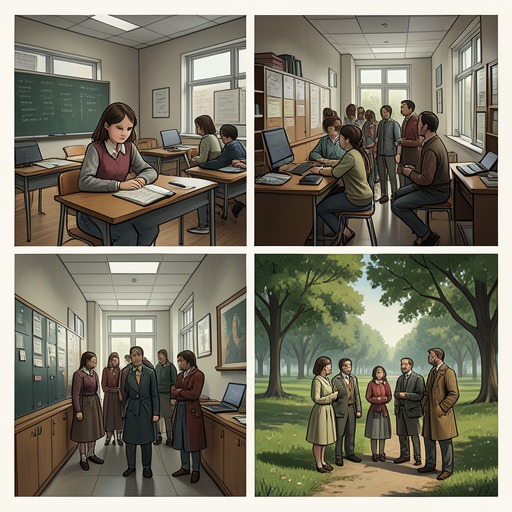
The principle takes concrete form in Hannah’s account of a classroom exercise organized by Mrs. Bradley. At the back of the class, Mrs. Bradley kept a paper bag on the spinning bookrack for anonymous notes about her teaching and suggestions for future discussions. Students had used the bag to propose topics including abortion, family violence, and cheating, without being asked to identify themselves.
Hannah used it to propose a discussion of suicide. Her note said, “Suicide. It’s something I’ve been thinking about. Not too seriously, but I have been thinking about it.” She wrote the note over and over, discarding or crumpling earlier versions before delivering it. The repeated drafting shows the strain involved in making the disclosure, while the softened qualification does not erase the fact that she had been thinking about suicide.
When the class would not discuss suicide without specifics, Mrs. Bradley spent about ten minutes giving local statistics. She explained that juvenile suicides might not be reported in the news if they occurred outside a public place with witnesses, and that families might describe a death as an accident rather than disclose that their child had died by suicide. The result, she said, could be that a community did not know what was happening among its members. Yet a thorough discussion did not follow. Hannah remains uncertain whether her classmates wanted details out of curiosity, a belief that specifics would help, or both.
Warning Signs and Unanswered Recognition
The classroom episode makes the expression more than an abstract statement: a private thought reaches the room in written form, but the response fails to become the sustained conversation Hannah had sought. The gap matters because the note is both a specific disclosure and an invitation to address a subject that the class instead approaches through statistics. The narrative places the existence of a warning beside the limits of the response, without making that one moment the explanation for everything that follows.
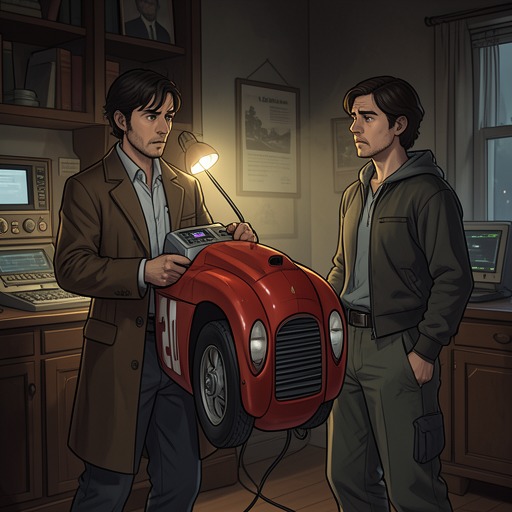
Elsewhere, the pattern appears in Hannah’s decision to give Tony her bicycle. She says she is done with it and offers no reason when he asks; Tony later understands the gift as a sign he missed. He recalls that Hannah said he was the only person she could think of who might need it, since he drove the oldest car at school and could use a backup if it broke down. The ordinary practical explanation and the later recognition coexist: the gesture acquired significance in a life whose distress Tony could not fully see.
The phrase also frames the book’s attention to Hannah’s direct expressions of despair. In a conversation with Mr. Porter, she says she needs everything to stop, including people and life. The narrative emphasizes that she wants him to notice what she has said and help her. Read alongside her earlier written note, the exchange underlines the cost of failing to recognize a request for help as part of a larger pattern rather than as an isolated statement.
Meaning and Limits
Hannah’s explanation refuses a neat division between a harmful act and the rest of the life it enters. Its force lies in the contrast between the apparent smallness of individual moments and their participation in cumulative pressure: the paper note, the bicycle, and words spoken to a school adult are distinct events, but each bears on whether Hannah’s distress is seen and answered.
The expression is not a claim that every consequence can be predicted, or that one person or incident accounts for Hannah’s death. Instead, it names the difficulty of isolating causes in a life affected by multiple relationships and circumstances. As a recurring interpretive principle, it asks the reader to attend to connections, including the connections other characters recognize only afterward.